Choosing a Stainless Steel Sink Strainer looks simple until water drains slowly, food particles escape, or the basket rattles under the tap. The right choice depends on fit, steel quality, drainage design, and daily cleaning habits. A bright surface alone proves little.
Grand View Research identifies corrosion resistance, durability, and hygiene as important drivers in the stainless steel sink market. The 2024 U.S. Houzz Kitchen Trends Study also shows continued homeowner investment in sink and plumbing upgrades. These findings matter because a strainer is a small component with a large effect on kitchen maintenance. Look for 304 stainless steel, a precise basket diameter, a stable flange, and a removable catch cup. Check the sink opening first. Many buying mistakes begin there.
Richard Trethewey, plumbing expert at This Old House, offers a useful maintenance principle: “Keep solids out of the drain before they become a plumbing problem.” That advice explains the strainer’s real purpose. A fine perforation can catch rice and coffee grounds, but it may drain slowly. Larger openings drain faster, yet allow more debris through. There is no perfect design.
Certification and manufacturer documentation deserve attention. ASME A112.18.2 and CSA B125.2 cover waste fittings and related plumbing performance requirements. However, not every inexpensive product lists meaningful compliance information. That should make buyers pause. Compare steel grade, gasket material, basket depth, installation measurements, and replacement availability. A few minutes beside the sink can prevent months of odor, blockage, and frustration.
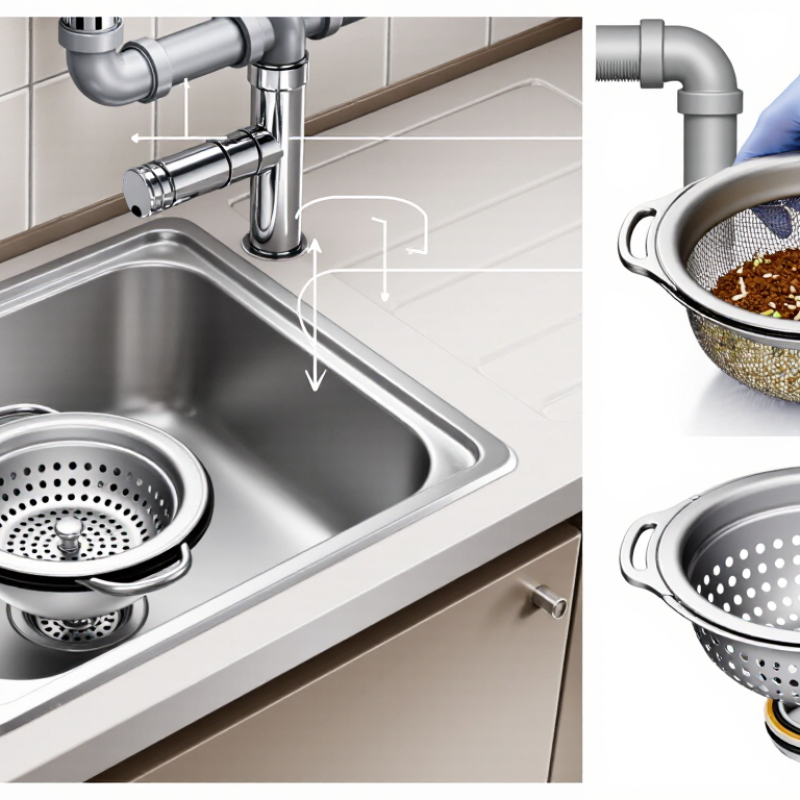
How to Choose a Stainless Steel Sink Strainer?
Identify Sink Compatibility: The 3.5-Inch Drain Opening Standard
A stainless steel sink strainer usually fits a nominal 3.5-inch drain opening, equal to about 89 millimeters. This size is common in residential kitchen sinks, but it is not universal. Before purchasing, measure the opening from the underside of the sink flange, not only from the visible top ring. A thick sink lip can create a misleading measurement.
The ASME A112.18.2/CSA B125.2 plumbing standard provides recognized requirements for waste fittings, including dimensional performance and leakage control. Installers commonly use these requirements when evaluating sink drain assemblies. The 2024 Houzz U.S. Kitchen Trends Study also identifies stainless steel as the leading sink material, showing why compatible strainers remain a practical replacement choice. However, material popularity does not guarantee dimensional compatibility.
Check the drain body, gasket thickness, retaining nut, and connection size. A 3.5-inch opening may still reject a strainer with an oversized flange or shallow basket. Measure twice.
I have learned that “standard” is only a starting point. Older sinks, farmhouse-style basins, and imported models may use different openings. Place the existing strainer beside the product drawing, then compare flange diameter, basket depth, and outlet threading. A small mismatch can cause seepage beneath the cabinet, even when the top ring appears correct. Always confirm the manufacturer’s technical dimensions before installation.
Measure the sink drain opening before choosing a strainer. A 3.5-inch opening is the common standard for many kitchen and utility sinks, while bathroom lavatories typically use a smaller opening.
When choosing a stainless steel sink strainer, start with the steel grade, not the finish. Type 304 stainless steel is widely used because it contains about 18% chromium and 8% nickel. These elements help form a passive surface that resists rust, food acids, and daily moisture.
Technical guidance from the Nickel Institute describes 304 as an austenitic grade with strong corrosion resistance for kitchen environments. ASTM A240 gives a broader composition range, including approximately 18–20% chromium and 8–10.5% nickel. This matters because a strainer faces water, salt, detergent, and trapped food every day. In my experience, the nickel content also supports toughness during pressing and bending. A thin, poorly formed basket can still deform, though.
Look for clear material information, consistent perforations, and a smooth underside. Sharp edges may collect residue. A 304 strainer should not show orange staining after ordinary use, but surface contamination can create misleading marks. Stainless steel is not maintenance-free. Rinsing away salt and drying the rim helps.
Some sellers use “18/8” as a simple description. It is useful, but not complete proof of grade. Independent material testing, such as X-ray fluorescence analysis, provides stronger verification. The World Stainless industry reports continue to show stainless steel’s broad use in food and household applications, yet application conditions still matter. For highly salty or chemically aggressive settings, 316 may deserve comparison, although its added molybdenum increases cost. A careful buyer should question vague claims.
Choosing a stainless steel sink strainer starts with the food waste your kitchen produces. Mesh size controls what enters the drain. Fine mesh catches coffee grounds, rice, onion skins, and small crumbs. However, very fine screens can clog quickly when greasy food is rinsed away.
A medium mesh often handles daily washing with less scrubbing. It is a compromise.
If your household prepares leafy vegetables or fibrous peels, inspect the basket after several meals. Large openings drain water faster, but they may let chopped food pass into the pipe.
This can create deposits around bends, especially where drainage is already slow.
For heavier food waste, choose a sturdy basket with smooth perforations and enough depth to hold scraps. Check that the rim sits flat against the sink opening.
A loose fit invites leaks.
Drainage needs should guide the final choice, not appearance alone. Measure the opening, outlet diameter, and clearance below the basin. A deep strainer may block a low waste pipe, while a shallow one may lack useful capacity.
During installation, run cold water and test the flow with a handful of crumbs. Do not trust a quick visual check. Stainless steel resists corrosion, but it still needs regular cleaning beneath the flange.
I have found that easy removal matters more than an extremely fine mesh. That preference may change with a food waste unit or sandy produce.
Reviewing real kitchen habits is worthwhile, because the ideal filter is often the one cleaned consistently.
How to Choose a Stainless Steel Sink Strainer?
Measure the sink opening before choosing a stainless steel strainer. Do not rely on appearance alone. Check the opening diameter, flange width, basket depth, and tailpiece size. Many kitchen sinks use a standard opening, but small differences can cause trouble. A flange that sits unevenly may leave a visible gap around the drain.
Gasket material also affects long-term performance. EPDM and silicone gaskets usually resist water, heat, and household cleaning products well. Natural rubber may compress faster, especially under frequent hot-water use. Check the gasket thickness and shape against the sink surface. I once focused on the metal finish and overlooked the gasket profile. That small mistake caused slow dripping beneath the cabinet.
Leak resistance depends on more than tight threads. A properly seated gasket should contact the sink evenly. Remove grit, old sealant, and trapped debris before installation. Hand-tighten the locknut, then add only a controlled turn with a wrench. Excessive force can distort the flange or damage the gasket. Follow the fitting instructions carefully, since some designs require sealant while others do not. After installation, fill the basin and drain it several times. Place a dry tissue beneath the connection. It reveals tiny leaks better than a quick visual check. Recheck the joint after a day of normal use. A perfect first impression is not always proof of a reliable seal.
| Selection Dimension | Typical Specification or Option | Why It Matters | Recommended Check |
|---|---|---|---|
| Nominal drain opening | 3.5 in (approximately 89 mm) is a common kitchen sink size; some sinks use 3.25 in (approximately 83 mm) or other sizes. | The strainer body must fit through the sink opening and match the drain assembly. | Measure the opening diameter at the sink basin, not only the old strainer’s outer rim. |
| Sink thickness | Many standard sink strainers accommodate roughly 1/16–1/8 in (1.5–3 mm) sink material, but the approved range varies by design. | Insufficient thread engagement can cause a loose connection, while excessive thickness may prevent the locknut from tightening. | Compare the sink thickness with the manufacturer’s allowable mounting range and threaded body length. |
| Top flange outside diameter | Common kitchen strainer flanges are approximately 4.5 in (114 mm) in diameter, although actual dimensions differ by model. | The flange must cover the drain opening and provide enough surface for the sealing compound or gasket. | Confirm the flange will sit flat on the sink without contacting nearby ribs, grooves, or curved surfaces. |
| Basket or perforated insert | Choose a removable basket with corrosion-resistant stainless steel and evenly distributed drainage openings. | A removable basket helps retain food particles while allowing the insert to be emptied and cleaned. | Check that the basket lifts out easily and does not wobble, bind, or leave large gaps around its edge. |
| Flange and basket material | Stainless steel is preferred for the exposed flange and basket because it resists rust and tolerates normal kitchen temperatures. | Material quality affects service life, surface appearance, and resistance to household cleaners and moisture. | Look for clearly stated stainless-steel construction and a smooth, burr-free finish. |
| Upper sealing gasket | Common options include EPDM rubber, silicone, and plumber’s putty used with a compatible strainer design. | The upper seal prevents water from passing between the flange and the sink surface. | Choose a gasket that remains elastic, is suitable for wet plumbing environments, and matches the sink surface. |
| Lower gasket and friction ring | A lower rubber gasket is commonly paired with a fiber or metal friction ring and a threaded locknut. | The lower components distribute tightening pressure and help maintain compression under the sink. | Verify that the gasket sits evenly and that the locknut engages sufficient thread without cross-threading. |
| EPDM gasket | Synthetic rubber known for good resistance to water, steam, ozone, and weathering. | It is a practical option for standard sink drainage where petroleum-based chemicals are not involved. | Use only where the gasket’s temperature and chemical-resistance requirements are satisfied. |
| Silicone gasket | Flexible elastomer with broad temperature capability and good resistance to aging and moisture. | It can retain flexibility over time when correctly sized and compressed. | Confirm that the gasket is designed for plumbing use and is not twisted during installation. |
| Threaded locknut | A large locknut should provide even compression around the drain body. | Even compression is essential for maintaining the seal and preventing movement. | Tighten securely according to the installation instructions; avoid excessive force that could deform the gasket or sink. |
| Leak-resistance design | Preferred features include a flat flange, correctly sized gaskets, full thread engagement, and a stable locknut. | Leak prevention depends on the complete sealing system, not on the metal strainer alone. | Inspect the sink and drain surfaces, center the assembly, tighten evenly, and perform a fill-and-drain leak test. |
| Connection compatibility | The outlet should match the connected waste pipe or trap, commonly using a compatible nominal drain connection. | A dimensional mismatch may require adapters or can create alignment and leakage problems. | Measure the existing pipe connection and check thread, tailpiece, and trap compatibility before purchasing. |
| Cleaning and maintenance | Removable baskets, smooth surfaces, and accessible sealing areas simplify routine cleaning. | Regular cleaning reduces buildup that can restrict drainage or interfere with the basket’s seating. | Rinse food residue regularly and avoid abrasive tools or harsh chemicals that may damage the finish or gasket. |
A stainless steel sink strainer faces water, food acids, salt, and cleaning chemicals every day. Coastal kitchens add airborne chloride, which can trigger pitting around holes and seams. For this setting, 316 stainless steel deserves careful attention. ASTM A240 specifies approximately 2–3% molybdenum in 316 grades, alongside chromium and nickel. Molybdenum improves resistance to chloride-related pitting. It does not make the strainer corrosion-proof.
The International Molybdenum Association’s coastal-environment guidance identifies molybdenum as a key alloying element for resisting localized corrosion. ISO 9223 also shows that marine atmospheres can reach higher corrosivity categories than sheltered inland environments. Therefore, a 316 strainer is a sensible choice near beaches, docks, or saltwater ventilation. Check the actual material certificate when possible. Surface appearance alone proves little. A polished strainer may still contain a weaker grade. I have seen buyers focus on shine and overlook the alloy. That mistake is understandable, but costly.
Tips: Choose a 316 strainer with clean, rounded perforations and a stable basket. Avoid sharp seams that trap salty residue. Rinse it with fresh water after heavy use, then dry it. Do not use chlorine bleach routinely. Inspect welds and drain edges every few months. If tea-colored spots appear, review the cleaner, water quality, and ventilation before replacing the part. Even 316 can suffer when salt remains trapped for weeks.
It usually contains about 18% chromium and 8% nickel. These elements help resist rust, food acids, salt, and moisture. It suits everyday kitchen conditions.
No. It describes approximate chromium and nickel content. Independent material testing gives stronger confirmation. Vague claims deserve careful questions.
Look for clear material information and evenly formed perforations. Check the underside for smooth surfaces. Sharp edges can trap food residue.
It should resist ordinary staining, but contamination can create orange marks. Salt, iron particles, and trapped food may affect the surface. Rinse and dry it regularly.
Measure the sink opening, flange width, basket depth, and tailpiece size. Do not trust appearance alone. Small gaps matter.
EPDM and silicone generally resist water, heat, and household cleaners. Natural rubber may compress sooner under repeated hot-water use. Check the gasket shape and thickness.
Clean away grit, old sealant, and debris first. Seat the gasket evenly against the sink. Hand-tighten the locknut, then turn it slightly with a wrench.
Fill the basin and drain it several times. Place dry tissue beneath the joint. It can reveal tiny leaks better than quick visual inspection. Recheck the connection the next day. A perfect first check can mislead.
Choosing the right Stainless Steel Sink Strainer begins with confirming that it fits your sink’s drain opening. In many kitchens, the standard size is 3.5 inches, but measuring the opening and checking the strainer’s overall dimensions can help prevent installation problems. Material quality also matters: 304 stainless steel, typically made with about 18% chromium and 8% nickel, offers a strong balance of corrosion resistance, durability, and everyday performance.
The filter design should match your cooking habits and drainage needs. Consider the mesh size, the type of food waste commonly produced, and how easily the strainer can be cleaned. A reliable gasket and secure sealing structure are essential for reducing leaks, while durable gasket materials can improve long-term performance. For homes near the coast or in areas with salty, humid air, 316 stainless steel may provide additional corrosion resistance because it contains approximately 2–3% molybdenum.

Jinrenkang Hardware